
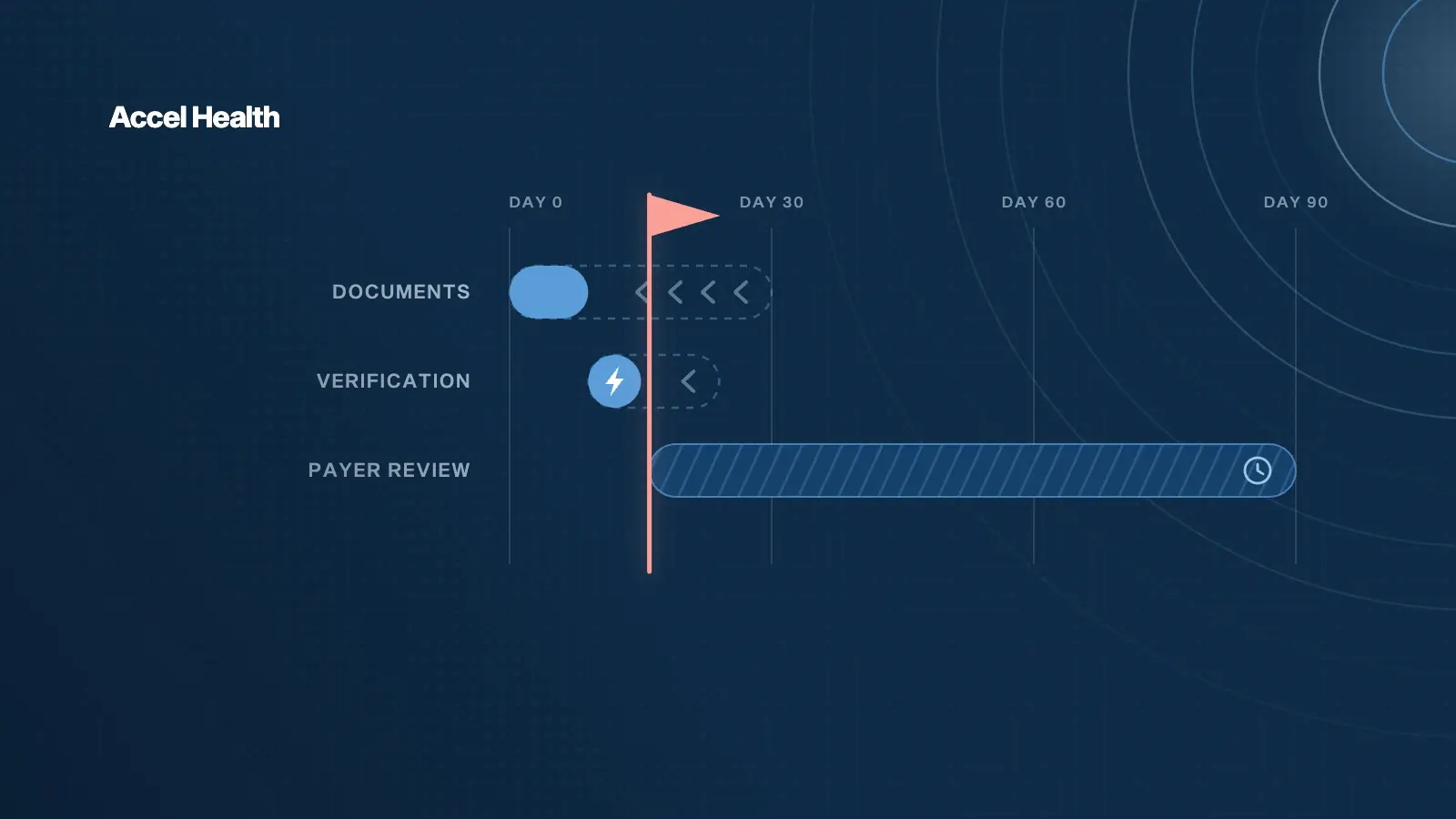
Most teams ask one question before any other: how long does physician credentialing take? The honest answer is the one nobody likes. It depends, and most of the timeline is outside your control. Physician credentialing typically takes 60 to 90 days, and sometimes longer. But that single number hides the real story, which is that credentialing is several stages stacked together, and they do not all behave the same way.
This breakdown walks through each stage, what it realistically takes, and where the delays actually come from, so you can tell which parts you can speed up and which parts belong to the payer.
The Short Answer
Traditional physician credentialing takes 60 to 90 days from start to finish. Clean cases with complete documentation can finish faster. Complicated ones, with multiple states, gaps in work history, or slow-responding payers, can stretch past 120 days.
But "credentialing" usually refers to two distinct processes that get lumped together: verification, which confirms the provider is qualified and who they say they are, and payer enrollment, which gets the provider approved to bill each insurance payer. Understanding the split is the key to understanding the timeline.
Stage 1: Document Collection (Days to Weeks)
Before anything can be verified, the provider has to supply their information: medical education, residency, state licenses, DEA registration, board certifications, malpractice history, and detailed work history.
This stage is where a surprising amount of time disappears, and it is worth being clear about why. A lot of practices already own a credentialing tool that stores these documents, but storage is not the same as progress. A system that holds files is closer to a shared drive than a credentialing engine. It keeps your documents in one place, but it does not verify them, and it does not submit anything. The work still has to happen somewhere.
The bigger issue is document quality. Providers often submit out-of-date or incomplete documents, and a single missing board certificate or expired malpractice policy stalls everything. Nothing downstream can start until the documents are accurate and verified. This is also the most controllable stage. A structured intake process, where the provider sees exactly what is required and submits it up front, can compress this from weeks to days.
Stage 2: Primary Source Verification (Minutes to Days)
Once documents are in, each credential has to be verified at its primary source: confirming the license with the state board, checking the DEA registration, screening against OIG and SAM exclusion lists, and validating the NPI.
Done manually, this takes days. Staff call boards, log into databases, and wait on responses. Done with automation, the same checks take minutes: a license in about a minute, OIG and SAM in about 30 seconds, NPI instantly. This is the stage where technology makes the biggest dent in the timeline, and it is what clears the way for clean applications.
Stage 3: Payer Enrollment (30 to 90+ Days)
This is the longest stage, and the one no vendor controls. After a clean application is submitted to a payer, the payer runs its own review before the provider can bill.
Timelines vary by payer type:
- Commercial insurance: typically 30 to 45 days, with many plans becoming billable around 45 to 60 days
- Medicare and Medicaid: 60 to 90 days
- California Medi-Cal and similar government plans: up to 6 months
Realistically, a clean file can be verified and ready to submit in about 30 to 45 days on the preparation side. After that, commercial plans like Blue Cross Blue Shield often become billable within 45 to 60 days, while government payers such as Medicare, TRICARE, and Medi-Cal take longer. A payer may acknowledge or confirm approval within days if the file is clean, but full activation, which includes assigning a provider ID, loading the provider into claims systems, and updating the provider directory, follows the longer timeline. Anyone who promises to compress the payer's review is promising something they cannot deliver.
Where the Delays Actually Come From
Most credentialing delays are not caused by the payer's review clock. They are caused by avoidable problems earlier in the process:
- Incomplete or out-of-date documents at intake
- Errors that bounce an application back for resubmission, resetting the payer's clock
- Manual verification that drags on for days
- Applications that sit because no one is following up with the payer
That last one is the quiet killer. It is entirely possible to pay for credentialing, hand off your applications, and then lose all visibility into where they landed. We have heard from providers who waited many months with no communication, no status, and no idea whether their application had even been submitted, until someone finally escalated directly to the payer to force movement. The payer's review time is fixed. The lack of follow-up is not, and it is where months can quietly disappear.
How to Speed Up Credentialing
You cannot shorten the payer's review, but you can shorten everything else and make sure the payer's clock starts as early as possible:
- Collect complete, accurate documentation up front
- Verify credentials automatically rather than by hand
- Submit clean applications that will not bounce back
- Follow up with payers consistently so files do not stall
This is the model Accel Health is built on. Documents live on a platform that verifies them automatically, applications are prepared clean by a dedicated, US-based enrollment team, and that team follows up with payers, handles escalations, and reports status back so you always know where each provider stands. The payer timeline is still the payer's, but everything leading up to it, and the persistence afterward, is handled.
When all documents are uploaded, the Accel Health team can get the enrollment submitted within days. We also manage all the follow up via our end-to-end enrollment services. To see how it works, take a look at the Accel Health credentialing platform or book a demo.
FAQ
How long does physician credentialing take on average?
Physician credentialing typically takes 60 to 90 days from start to finish. Clean cases with complete documentation can move faster, while complex cases involving multiple states or slow payers can take 120 days or more. The timeline includes document collection, primary source verification, and payer enrollment.
Why does credentialing take so long?
Most delays come from avoidable problems: incomplete or out-of-date documents at intake, errors that cause applications to bounce back, slow manual verification, and lack of follow-up with payers. The payer's own review adds 30 to 90 days depending on the payer type, and that portion is outside any vendor's control.
Can credentialing be done faster?
The parts you control can be compressed significantly. Automated verification turns days of checks into minutes, structured intake prevents missing-document delays, and clean applications avoid the resubmission cycle. A clean file can often be ready to submit in 30 to 45 days. The payer enrollment review itself, 30 to 90 days and longer for government plans, cannot be shortened, but starting it early with a clean file and following up consistently is how you minimize total time.
Share Article


