
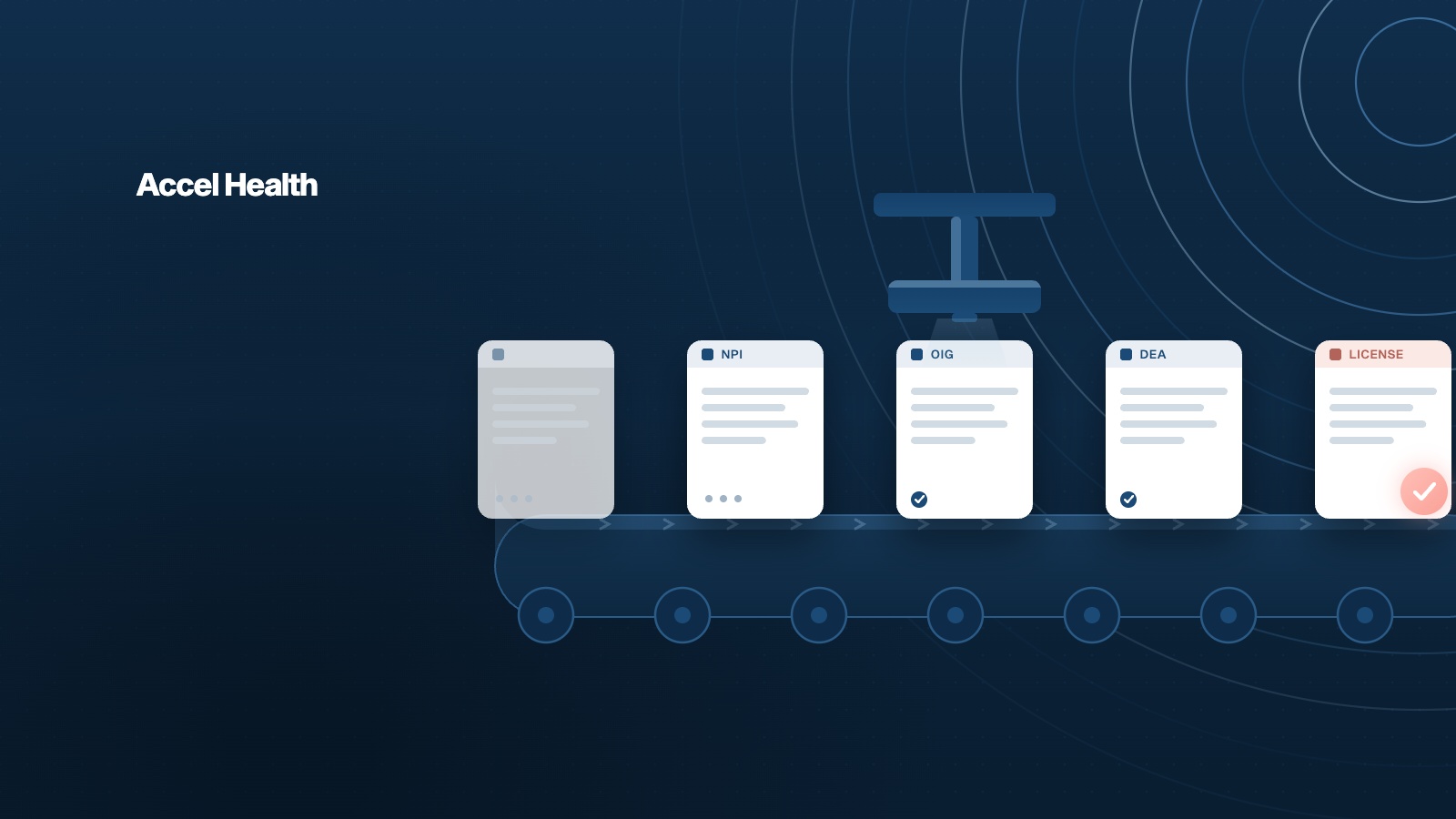
Primary source verification is the part of credentialing that should be fast and almost never is. Confirming that a license is real, a DEA registration is active, and a provider is not on an exclusion list should take seconds. Done by hand, it takes days. Automation is what closes that gap, and it is the single biggest lever for shortening the part of credentialing you actually control.
Here is what primary source verification is, why the manual version is so slow, and what automating it actually changes.
What Is Primary Source Verification?
Primary source verification, or PSV, means confirming a provider's credentials directly with the organization that issued them, rather than trusting a copy the provider hands you. A license is verified with the state medical board. A DEA registration is checked against the DEA. Exclusion status is confirmed against the OIG and SAM databases. The NPI is validated at its source.
PSV exists because payers and accreditation bodies require it. A photocopy of a license is not proof. The credential has to be confirmed at the source, with documentation that it was checked and when. This is non-negotiable, which is exactly why making it fast matters so much.
Why Manual PSV Is So Slow
Done manually, PSV is a series of small waits that add up.
A coordinator logs into a state board website, searches for the provider, confirms the license, and saves a screenshot. Then the DEA. Then the OIG exclusion list. Then SAM. Then the NPI registry. For one provider that is a chunk of an afternoon. For a group onboarding a dozen providers, it is days of repetitive lookups, and that is before anyone follows up on a discrepancy.
The waiting is not the only cost. Manual lookups introduce errors: a transposed number, a missed middle initial, a screenshot saved to the wrong folder. And when an auditor later asks for proof that a credential was verified on a specific date, someone has to go find it.
What Automation Changes
Automated PSV queries the primary sources directly and returns verified results in a fraction of the time:
- Medical license: verified in about 1 minute, versus 3 to 5 days manually
- DEA registration: verified in about 1 minute, versus 2 to 3 days
- OIG and SAM exclusion checks: about 30 seconds, versus a full day
- NPI validation: instant, versus 1 to 2 days
The speed is the headline, but the consistency matters just as much. Automated verification captures a screenshot and timestamp for every check automatically and stores it in an audit-ready folder. There is no scramble when an auditor asks for proof, because the proof was captured the moment the check ran.
It also changes what your specialists spend their time on. Instead of running lookups, they review results and handle the cases that need judgment, like a license that comes back with a flag or a name that does not match. The repetitive work is absorbed; the work that needs a person stays with the person.
Why PSV Speed Decides the Whole Timeline
PSV sits at a critical point in the credentialing process. Everything downstream, payer enrollment included, depends on a clean, verified file. If verification drags, the entire timeline slides with it. If verification is instant and accurate, the payer enrollment clock can start days or weeks sooner.
This is why automating PSV is the highest-leverage change in credentialing. It is the one stage where technology turns days into minutes, and because it gates everything after it, those saved days compound. A clean file ready to submit in 30 to 45 days instead of 60 means the payer's review, which no one can shortcut, starts that much earlier.
How Accel Health Handles PSV
Accel Health runs automated primary source verification on licenses, DEA, OIG, SAM, and NPI, capturing screenshots and timestamps automatically and storing everything in audit-ready provider folders. Verification that traditionally takes days happens in minutes, which clears the way for the enrollment team to prepare and submit clean applications without waiting on manual checks.
The result is not just speed for its own sake. It is a verified, audit-ready file that lets payer enrollment start as early as possible, which is where the real timeline savings come from.
To see automated verification in action, take a look at the Accel Health platform or book a demo.
FAQ
What is primary source verification?
Primary source verification, or PSV, is the process of confirming a provider's credentials directly with the issuing organization rather than relying on copies the provider supplies. Licenses are verified with state boards, DEA registrations with the DEA, and exclusion status against OIG and SAM. Payers and accreditation bodies require it.
How long does primary source verification take?
Done manually, PSV takes days, with each credential requiring a separate lookup and screenshot. Automated PSV verifies a medical license in about a minute, DEA registration in about a minute, OIG and SAM exclusion checks in about 30 seconds, and NPI validation instantly.
What credentials are verified during PSV?
PSV typically covers the state medical license, DEA registration, OIG and SAM exclusion status, and NPI validation, along with education, board certifications, and work history depending on payer and accreditation requirements. Each is confirmed at its primary source with documentation of when the check was performed.
Share Article


